Dor Guez Munayer is an interdisciplinary artist working in photography, video, sculpture, installation, and performance. Guez’s work interrogates the intersection of his identity as someone born in Jerusalem to a Palestinian family from Lydda and Jewish immigrants from North Africa, in turn revealing the ways that personal narratives and historical accounts interact. Now, Guez lives and works between Jaffa and Athens. This conversation unfolded through a series of emails exchanged between June 4 and June 19, 2025, and considers paper from multiple perspectives: theoretical, social, preservation, historical, and material, all of which are contingent and entangled.
rachel winter (rw): How do you conceptualize paper within your practice?
dor guez munayer (dgm): We have to first understand that the preservation of paper—especially as a carrier of memory and history—is often a privilege. Cultures and communities that experience catastrophic events, wars, displacement, don’t always have the conditions or infrastructure to preserve paper. It’s fragile. It burns easily. It’s lost in floods, abandoned, and damaged over time. If there are no archives, no historians, no institutions to care for it, it disappears.
When the paper disappears, so do the stories. That’s where oral histories come in, and that’s also where my practice began: with the urgent need to preserve what little remained. I started collecting my family’s photographs and documents, not just because they were personal, but because they were fragile documents of a history that wasn’t being kept anywhere else. From there, it expanded to other families in my community, and then to other communities in the Palestinian diaspora. What we’re doing through The Christian Palestine Archive (CPA) project is not just scanning or digitizing—we’re giving the paper a second life. Each photograph and document is being transformed from a vulnerable physical object into something we can protect, share, remember.
For me, the most important image from my own family archive is a photograph of my grandmother on her wedding day, which was the first Palestinian wedding documented in Lydda after the 1948 war. The photographer gave them printed copies, and some of them survived. In Samira, you see my grandmother in her wedding dress, standing in the ghetto of Lydda, but the veil has been torn—literally. The paper is ripped, and through that tear, you can see the layers of the photograph like folds of snow-covered mountains. That tear has become symbolic, not only of what happened to us in 1948, but the fragility of the medium itself.
Photographs fade. Paper is impermanent. And if these materials aren’t preserved—whether through digitization, exhibition, or oral retelling—they vanish. That’s why the archive is a core part of my work: not to freeze time, but to resist erasure. To insist that even the most delicate trace—of a wedding, a gesture, a face—matters.
rw: What is the role of paper in writing history, particularly as it relates to your interest in the relationship between personal and “official” narratives?
dgm: Paper is never neutral. It carries the weight of power, authorship, and erasure. In my work, I often return to paper not just as material, but as evidence—as wound. Whether it’s a military map, a censored photograph, or a brittle family letter, paper holds the trace of decisions made by institutions, colonial regimes, and those who felt entitled to archive—and to omit. In this way, official narratives are not just told, but engineered through language, documentation, classification. Paper is central to that process: It is how land was divided, identities were legalized or denied, and memory was bureaucratized.
This isn’t abstract to me. In 1948, my family’s estate in Lydda was taken and turned into the official residence of the military governor appointed by the new state of Israel. Most of the homes in Lydda were destroyed, but this one still stands, and it has been repurposed as a medical center. My family was among the 2% of Lydda’s original inhabitants who were not deported, but who stayed and survived the war by hiding in the local church basement.
After the war, my grandfather asked for the house to be returned. The authorities asked for papers to prove their ownership. The house was looted, but my grandmother, who was incredibly resourceful, went back to the house. Amid the broken furniture and debris, she found a single paper: the document that proves ownership. The looters took property but not documents.
The house was never returned, but the existence of that piece of paper mattered, and not just for legal reasons. It was something deeper; a document that said: “we were here.” Paper in this context is not only an instrument of bureaucracy; it’s a remnant of truth, presence, and resistance. I try to hold onto and interrogate this in my work.
rw: Related to natural materials, construction, and place, can you also explain the significance of flora and fauna to your practice?
dgm: Flora and fauna are never just part of the background in my work. In the context of Palestine, and particularly in relation to constructing a national or colonial identity, plants and animals have always been politicized. They become instruments of ideology. Think for example about the renaming of Indigenous plants or the introduction of non-native species. Nature in this region has been cataloged, controlled, and even weaponized; nature is silent but never neutral.
The first time I worked directly with flora as image and metaphor was about ten years ago when I was invited to work with the American Colony Archive, which is the largest photography collection from the early twentieth century in the Levant. In a small room in Jerusalem, I discovered a handmade olive-wood book cover. When I opened it, I found pressed flowers arranged delicately on handmade paper—bouquets gathered from the Jerusalem hills. They were carefully designed compositions, and they functioned as souvenirs for pilgrims and tourists of all faiths visiting the “Holy Land.” Nature was aestheticized and arranged to fit a vision, not to reflect how it truly grows.
What struck me most was the paper itself. Underneath each bouquet was a thin silk sheet to absorb the moisture from the dried plants. Normally, these sheets are replaced by archivists, but this book had remained closed for over a hundred years. The silk paper absorbed not only moisture but pigment, leaving yellow stains—ghostly imprints of each flower. I photographed both the pressed plants and their residual marks and combined them into one composition. That act of emphasizing what was left on the paper rather than the flowers themselves became the heart of the project.
This attention to residue, to what survives the process of time and touch, opened a whole set of questions for me. These books weren’t scientific or objective illustrations. They were made by women of the American Colony—Americans living in Palestine—designing products for outsiders. These were objects of devotion and desire, but also of commerce. I don’t dismiss them for that. There’s something to be learned not just about the flora of this land, but about the people who chose to frame it, sell it, and carry it home.
Flora and fauna do not live in my work as scenery or passive décor, but as evidence, metaphor, and witness.
rw: How did this experience translate into a specific body of work?
dgm: After this, I made a series that I titled Lilies of the Field. The name borrows not from botany but the New Testament. The lilies referred to in the text are believed to be native to the region, and in Christian iconography, they’re associated with the Virgin Mary. Again, nature here becomes symbolic terrain—holy, politicized, gendered.
Paper here is then a material that not only documents but also preserves. In some archival contexts, it has acted as a surface that protects and stabilizes delicate materials—plants, for instance—by absorbing their moisture and imprint. In Lilies of the Field, paper functions not just as a background but as a medium that holds the trace of the plant, thus becoming part of its material history.
rw: Flora and fauna are also central to your recent series Khobiza. What is khobiza, and what does it mean to you?
dgm: Khobiza is a wild edible plant that grows freely across the Levant. It’s resilient. You don’t cultivate it; it simply appears—between cracks in the pavement, in abandoned lots, and in ruins. For generations, it has been known as the food of the poor—of survival. During times of war, people relied on it when there was nothing else to eat. The name “Khobiza” comes from the Arabic word for bread (khubz), a nod to its value as a substitute during times of famine.
This isn’t just a story of the past. I think back to my grandparents in 1948 hiding in a church and I also think of my relatives today in Gaza during the current war. Their homes were destroyed, their lives erased in a matter of seconds. They also found refuge in the local church, and they were forced to survive off the land. They told me they were collecting Khobiza to feed their children. Almost no food was reaching them, no aid: just this plant, growing from the soil. My relatives also share this testimony in my recent video, White Flag.
Khobiza is not a celebration of nature. It is a landscape of hunger—a portrait of war.
rw: How are you treating the Khobiza? Perhaps like an archivist or a botanist?
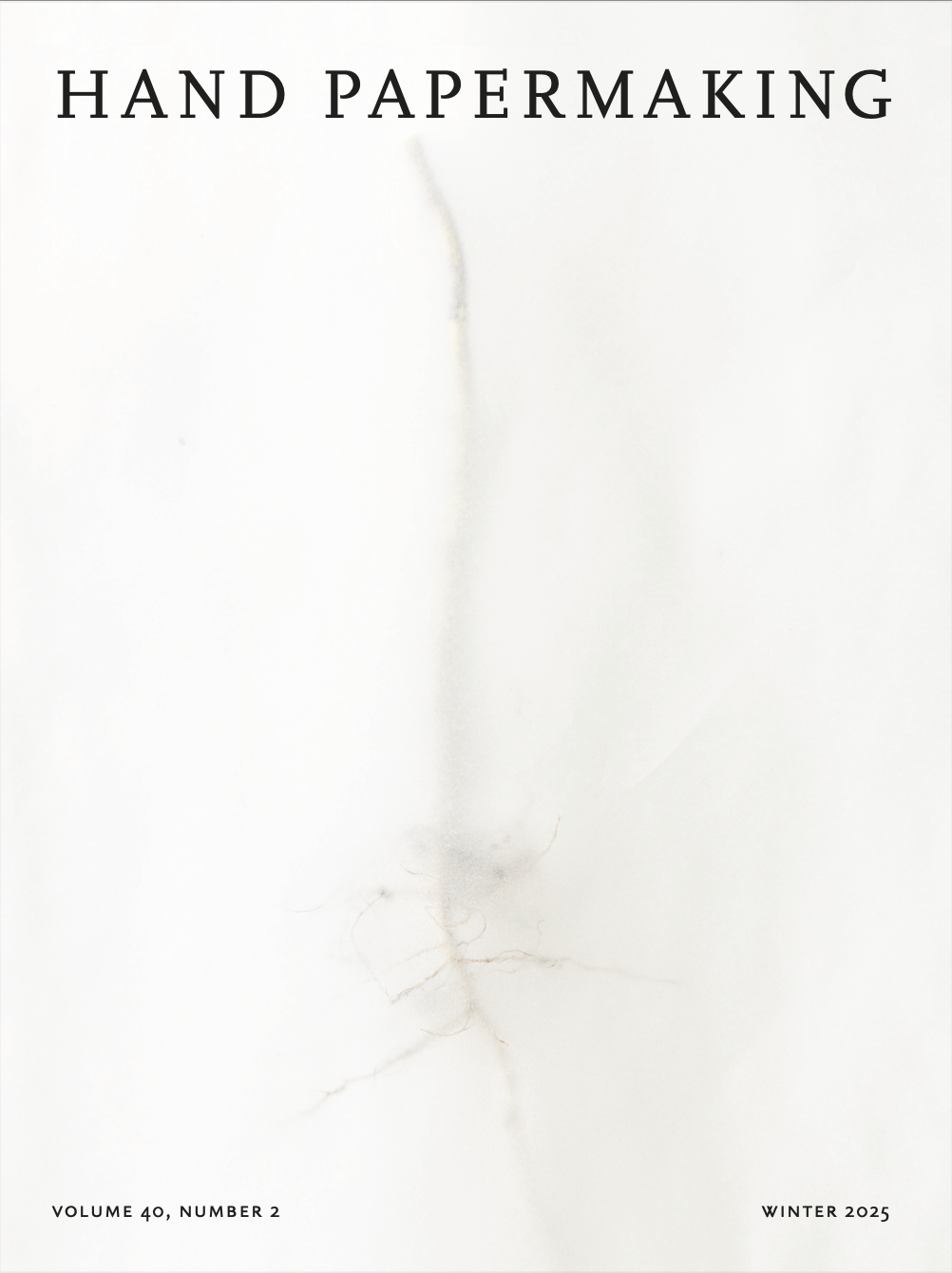
dgm: I began collecting Khobiza myself from the wild edges of Jaffa where I live. I pressed them like a botanist would, placing each plant between two sheets of paper. Just before they were fully flattened, I photographed them at that moment when the plant seemed to either sink into the paper or push against it. The final prints are one-to-one scale. They aren’t aestheticized. They’re almost forensic—fragments of evidence, visual testimonies. In some, you can see the roots, the decay, the color shift. Some look like silhouettes of human figures—fragile, standing, drying out. They aren’t beautiful in a decorative sense. Their presence is the point—their persistence.
rw: There’s an interesting comparison for me between Khobiza and the way nature is presented as natural, in this case to indicate survival, and Lilies of the Field, which is more stylized, and speaks to this history of tourism. In the latter, for example, your aesthetic choices are the opposite of the “natural” idea of pressed flowers for the tourist market. What are your thoughts on this particular reading? How would you differentiate the two series?
dgm: In many ways, Khobiza is a contradiction, or maybe a mirror image, of Lilies of the Field. The Lilies series is full of color with designed bouquets arranged on handmade paper, while Khobiza is stark, direct, and rooted in necessity.
In contrast to the carefully arranged bouquets of Lilies of the Field, Khobiza resists commodification. It doesn’t perform beauty; it holds pain, memory, and endurance. It documents something else entirely: survival in the face of annihilation.
The paper carries more than the plant itself; it preserves a moment, a gesture, a presence. Our role as visual historians is to pay attention to these traces, not only to the objects but the marks they leave behind.
rw: How are you thinking about color and nature, but also the relationship between paper, prints, and portability as they played a role in propaganda and “official” histories?
dgm: Printing my work on paper—the same kind of material that once legitimized imperial domination—is an act of refusal. It’s a gesture of reclaiming.
One example of this is my project Amid Imperial Grids. The identification of places through renaming, be that of titles, written records, or bureaucratic documents, was a fundamental strategy of colonial rule in the Levant. The British Mandate and the French Mandate both re-mapped and re-named the region. Paper was the primary tool for this through maps, surveys, censuses. They used it to impose logic and systems that divided, erased, and renamed.
In Amid Imperial Grids, I worked with historical maps that depicted the division of the region through what the colonial powers referred to as the “pink line”: a border drawn to split the Levant between them. I took those maps and removed every single title, border, name, and index—anything that wasn’t directly related to the physical topography. What remains is a large-scale image that looks like a map but doesn’t function as one. You see nature, but you cannot name it. You can’t locate yourself within it. It becomes raw—free of classification or ownership.
The process didn’t stop at erasure. Every time I removed a word or line, I was left with a void. That absence had to be reconstructed, reimagined. I had to redraw parts of the land—valleys, terraces, trees, and mountains—based on how I imagined they might have looked before borders were imposed. In many ways, these maps are partially invented; they are archival and speculative.
By stripping the map of its functionality, I’m pointing to the absurdity of imposed names and boundaries. I’m restoring nature’s original state, or at least acknowledging that we can never fully go back, but we can question the violence of cartography, naming, and claiming.
Paper becomes a battlefield and a poetic space, one where the naivety of nature persists regardless of human intervention. It reminds us that landscapes survive us, and they hold memories long after empires fade.
rw: We’ve talked a great deal about paper and history as record and documentation, but what else can paper be in the present and future?
dgm: I also see paper as a site of resistance. A torn image, a handwritten note in the margins of an official form: These are counter-archives. In my practice, I try to activate them, not to restore the past, but to question how it was constructed in the first place. Who was allowed to write history? Who was turned into a footnote?
There’s a deep cultural obsession with rebuilding and reconstructing, but I believe we must also allow ruins to remain as they are—visible, unaltered testimonies. We can also learn from what’s been left in fragments. A ruin, like paper, bears witness to catastrophe, displacement, and the lives of those who no longer inhabit a place. Sometimes, to be truly free is to demand that your history be acknowledged and preserved—not (only) reimagined.
Paper, for me, is not just a medium. It’s a site of confrontation, a space where history, politics, memory, and power unfold.
___________
NOTES
1. For more information on The Christian Palestine Archive, see: https://www.dorguez.com/copy-of-the-cpa.
2. White Flag will premiere at the Paiz Art Biennial in Guatemala in November 2025.
3. Khobiza and Amid Imperial Grids will be exhibited in "Land and Soil. How We Live Together" at K21, Kunstsammlung Nordrhein-Westfalen in Düsseldorf, opening on November 29, 2025.